History of the Cup and Trophy
For many centuries, a ‘trophy’ was simply something taken from one’s enemy – a piece of armour, perhaps, or occasionally even a body part – that was displayed after a battle as a piece of tangible evidence of triumph. This may have been a cup on occasion, but it is difficult to trace any examples of cups designed for the sole purpose of serving as trophies (in particular, for sporting events) until the mid-18th century.
Chalices were given to winners of sporting events in the New World at least as early as the late 1600s. For example, the Kyp Cup (made by silversmith Jesse Kyp), a small, two-handled, sterling cup, was given to the winner of a horse race between two towns in New England circa 1699.
Chalices in particular, are associated with sporting events, and were traditionally made in silver. Winners of horse races, and later boating and early automobile races, were the typical recipients of these trophies.
Cups
The title ‘cup’ encompasses a broad spectrum of vessels, from drinking cups and chalices, to two-handled lidded cups, used for ceremonial or presentation purposes (see trophies below for the latter). Inverted-bell-shaped cups on spreading stems, often with covers and impressive finials were popular in the late 15th century.
Steeple cups are a uniquely English style, dating back to the Elizabethan and Stuart periods, between 1590 and the 1630s. These statuesque, egg shaped cups standing on a tall spreading foot have a characteristic obelisk finial embellishing the domed cover. The function of such cups could be either religious, where the cup was used as a chalice, or secular, where the cup was for ornamental purposes.
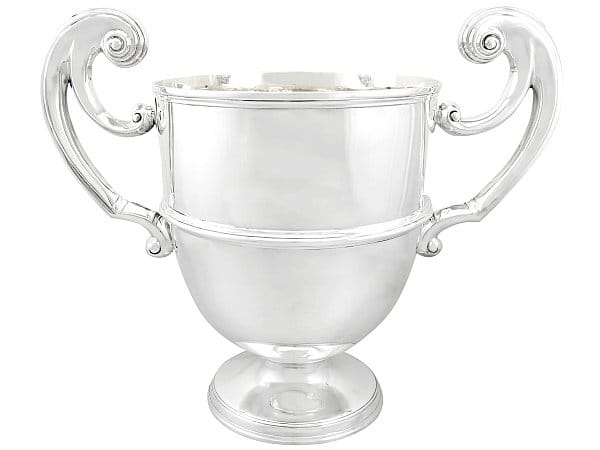
Small wine cups and/or goblets supported by a stem and foot were fashionable during the 1600s, but by the late 1700s, two handled cups known as ‘porringers’, caudle cups’ or ‘posset pots’ came into vogue. This style of cup continued to develop and by the mid-late 1800s, decorated and ornamented two handled cups of ogee form were produced. A slight variation in style during the 1900s resulted in taller, more majestic pieces, with embossed and chased decoration, establishing the presentation cup in the form we recognise today.
Trophies
The word ‘trophy’ is derived from the Greek word ‘tropaion’, from the verb ‘troupé’, meaning ‘to rout’, or the Latin word ‘trophaeum’, meaning ‘monument to victory’. The concept of winning an item belonging to your enemy as a trophy was first demonstrated by the Greeks. They displayed their ‘trophies’ of war, which included dead warriors, or entire ships, at the site of victory. The Romans, in a slightly more civilised manner, erected monuments, or special trophies in cities such as Rome in tribute to the victors.
Examples of trophies in the form of silver chalices, or two-handled cups (such as the Kyp Cup) from the late 1600s have been preserved. These kinds of items were presented to winners of sporting events such as horse racing.
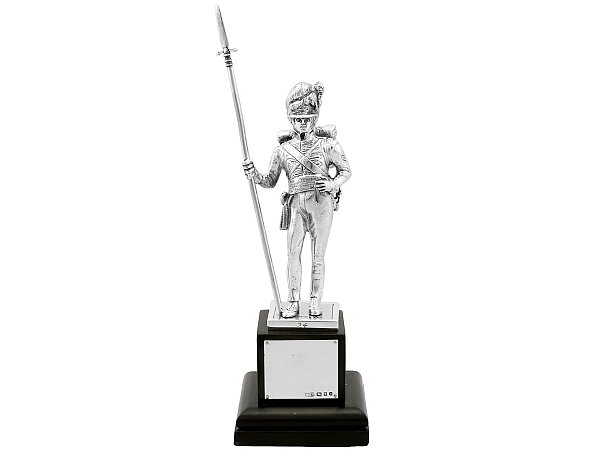
Trophies originally had a cup or chalice form, but over time, silver bowls and plates also became acceptable trophies.
A few famous trophies presented today are:
America’s Cup
First presented in 1851, the America’s cup is the most prestigious and oldest active trophy in international sailing. It takes the form of an ornate bottomless ewer, crafted in 1848 by Garrad & Co.
Wimbledon Trophies
The Wimbledon Championships is the oldest tennis tournament in the world, with the first Gentlemen’s Singles competition being held in 1877. The classical silver gilt two-handled cup, with an impressive pineapple finial presented to the men’s singles champion is still presented today. The large sterling silver salver, known as the Venus Rosewater Dish, made by the renowned silversmiths Elkington & Co. was first presented to the winner of the Ladies’ Singles competition in 1886.
FA Cup
The Football Association Challenge Cup competition is the oldest association-based football competition in the world, and was first held in 1871. The present FA Cup trophy is the fourth trophy to be used – the first was stolen (and melted down), the second was sold (and may now be seen at the National Football Museum). The third trophy made in 1911 is too fragile to be used, so a replica was made in 1992, and it is this magnificent sterling silver two handled cup which is still presented today.
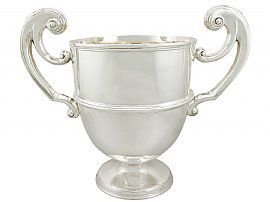
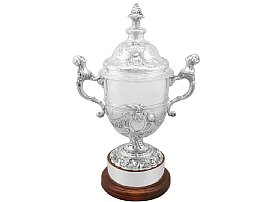
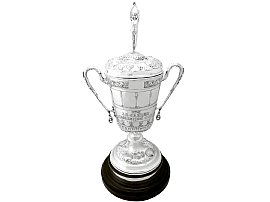
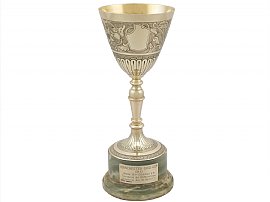
Here at AC Silver we have a selection of presentation trophies of a similar style, for example this Sterling Silver Gilt Presentation Cup and Cover which is fitted with two loop handles. This cup was crafted by Charles Frederick Hancock in 1871, coincidentally coinciding with that very first FA Cup Competition!
Proud Members of