Vintage and Antique Jade Rings
Browse our impressive range of antique and vintage jade rings, including stunning jade engagement rings
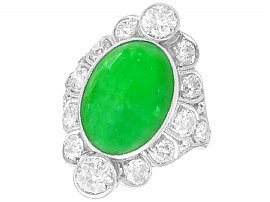
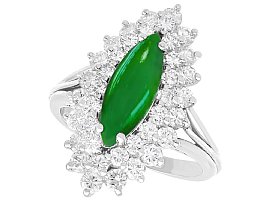


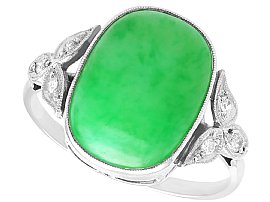
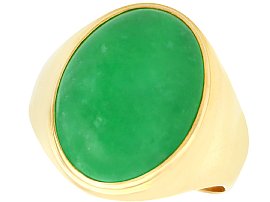
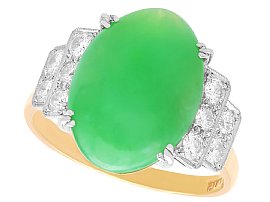
Explore our exceptional collection of antique jade rings, featuring fine examples from the Victorian, Edwardian, and Art Deco periods.
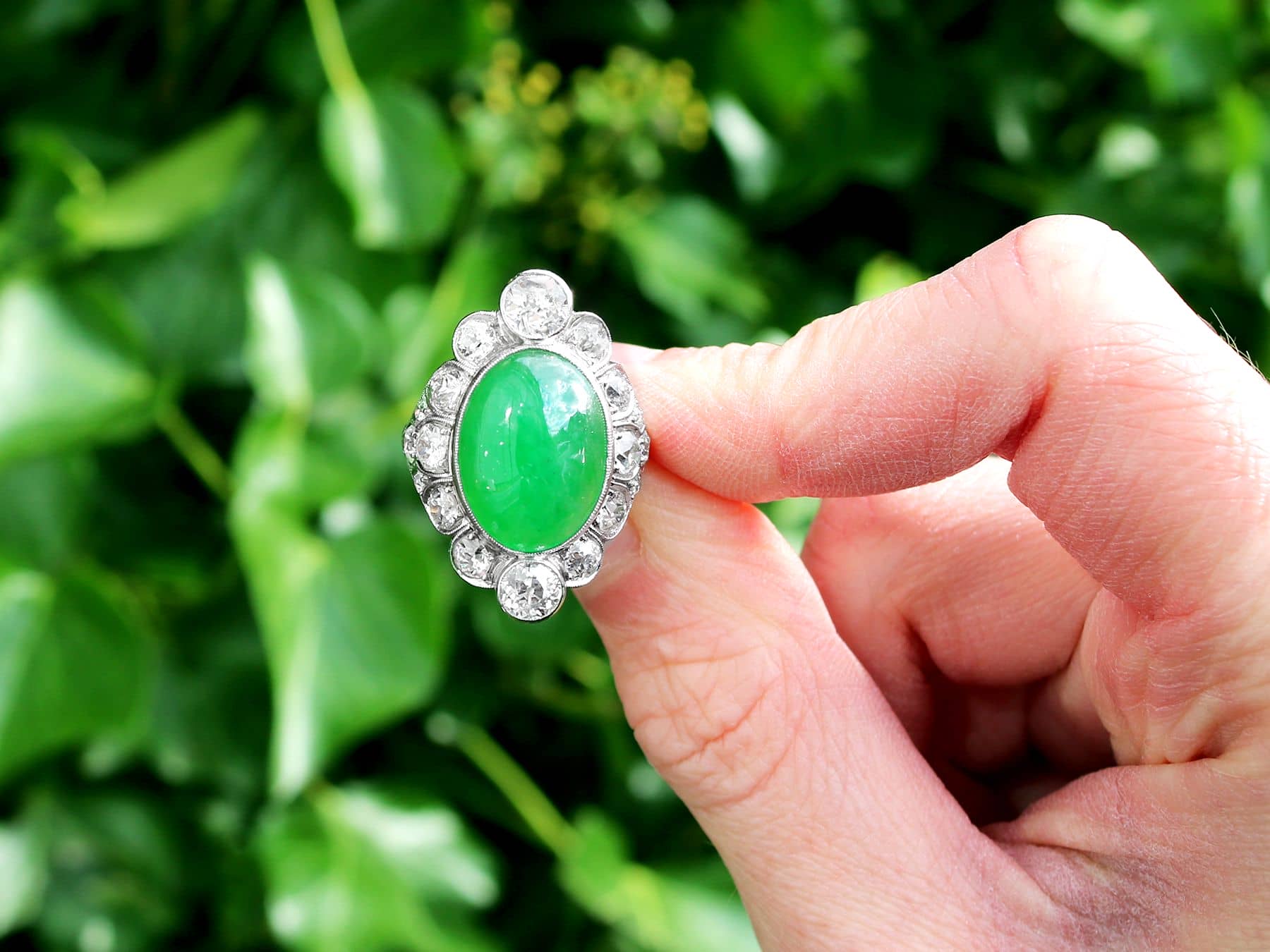
From richly coloured green jade cabochons to jade and diamond cluster designs, each ring showcases the timeless elegance and symbolic power of this revered gemstone.
Whether you're drawn to a Victorian jade solitaire or a bold Art Deco design, our carefully curated selection will surely assist you to finding that perfect jade dress or engagement ring.
Frequently Asked Questions
Jade is a term used to describe two different types of stone. The minerals nephrite and jadeite are interchangeably referred to as jade, although they do have subtle differences. Both were used to create a variety of tools and jewellery. Nephrite was more workable and also more resistant to damage and breakage, but both varieties of the stone are considered highly valuable.
Since the Stone Age, jade has been mined and worked in Chinese territories. At this time, jade was as practical as it was beautiful, being used to craft ornamentation and tools equally. Being a reasonably malleable stone, jade was carved with intricate decorations and used as jewellery for Imperial families of Ancient China.
The stone is often called the emperor's stone, partly because of its connection to Chinese royalty, and partly because the Chinese characters for ''emperor'' and ''jade'' are almost identical. During the Han Dynasty (202BC ¢â'¬" 220AD), the Shuowen Jiezi dictionary described jade as having five virtues. Honesty, integrity, benevolence, wisdom, and bravery were all attributed to the jade gemstone. Wealthy and influential figures from this era would sometimes be buried in jade suits, an extremely expensive entombing practise taking years to prepare.
Ancient South American cultures such as the Mayans and Aztecs also treasured jade very highly. The name for jade finds its roots in the Spanish phrase 'piedra de ijada', meaning 'flank stone'. This is because of the observation made by early Spanish colonisers in South America who noticed native populations using jade to ease pain in their sides. Even today, jade is considered a healing stone that is especially powerful against kidney pain.
Its use as a curative aid is only one interpretation of the meaning and uses of jade gemstones. The range of powers and meanings behind this stone are complex and deeply interesting, changing from one culture to the next.
Many aspects of Asian cultures are associated around the world with good fortune. Jade is widely regarded as a good luck stone synonymous with health and confidence. The nephrite form of jade is believed to soothe nerves, bringing a clearer headspace to anyone experiencing turmoil.
Some cultures associate jade with supernatural abilities. The Maori of New Zealand historically used jade for a variety of tools and weaponry. Heirloom pendants referred to as a hei-tikis were often carved from jade. These pendants required a lot of ceremony to be made, and were handed down through the generations of a family. These pendants were believed to allow ancestral family members to provide guidance to the living.
Jade also shares a connection to the heart chakra due to its green colouring. Green represents the heart chakra in the ancient system used to describe energies within the body. Naturally, with jade being a predominantly green gemstone, connections such as this are understandable. There are other colourings for jade beyond the green end of the spectrum, however.
Despite the overwhelming association between jade and the colour green, the gemstone has a range of colour variations. Shades of green are the most highly-valued of these variants; green jade is sometimes referred to as 'imperial' jade because of its inherent value.
White jade, usually termed 'mutton fat' jade, is a rarer colouring. Its milky white colour sometimes contains small hints of green shades, although it can be a pure white similar to ivory. At the 2008 Beijing Olympics, each medal featured a section of jade. The gold medals featured mutton fade grade, creating a unique contrast with the golden colour while honouring the history and culture of the stone.
Another popular variant of jade comes in the form of 'lavender' or 'lilac' jade. These purple gemstones range from pale pink-purple colours to rich, deep purple tones. Unlike the most well-known purple gemstone "the amethyst" lavender jade has a density to its colour that doesn't allow light to enter and refract. This rich colouring makes this variation of the stone especially appealing.
Red jade is a variation to which many traits and powers are attributed. Considered to be a 'chi' stone, the red colouring of jade supposedly channels warrior strength, eliminating the user's fears and doubts. This shielding gemstone is purportedly skilled at keeping negative energies away from the wearer.
Any more questions? Contact Us
Proud Members of