Antique and Vintage Jewellery Boxes
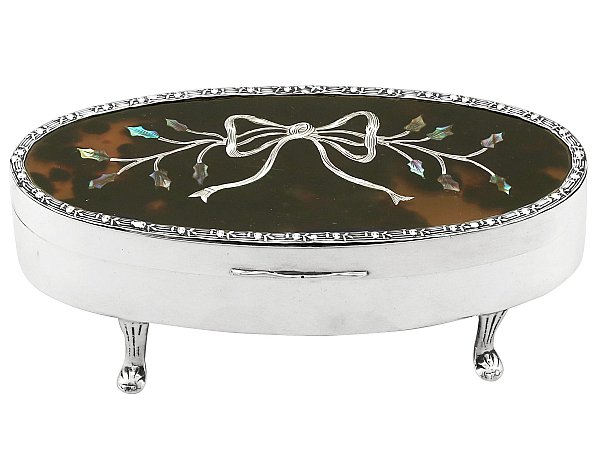
A fine collection of antique and vintage jewellery boxes, crafted in English sterling silver and featuring coloured enamel
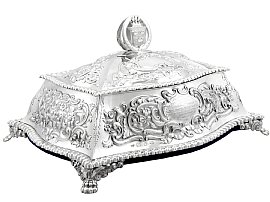
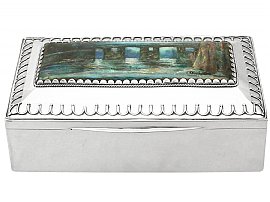
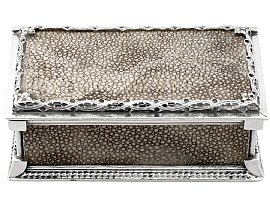
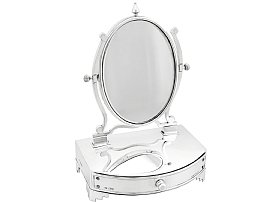
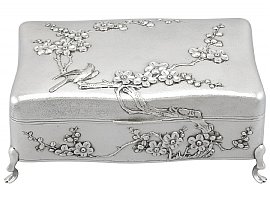

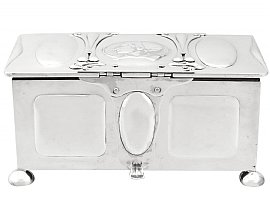
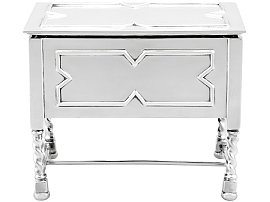
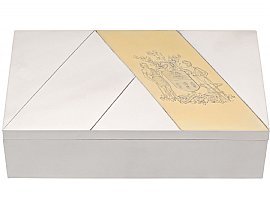
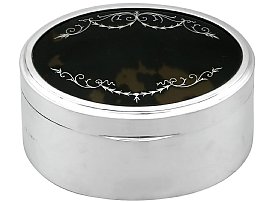
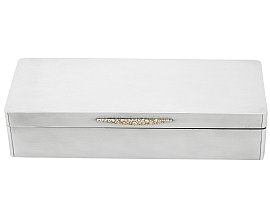
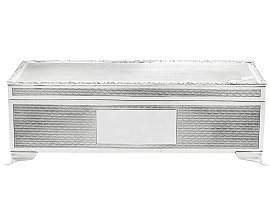
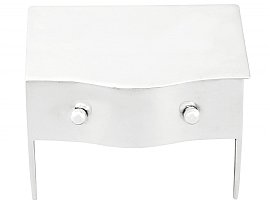
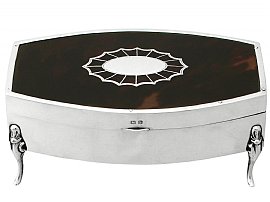
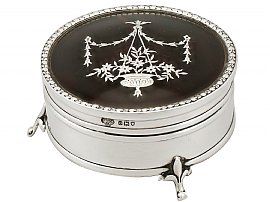
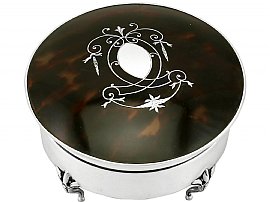
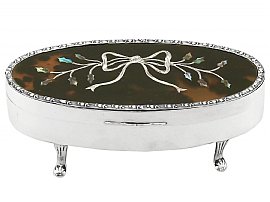
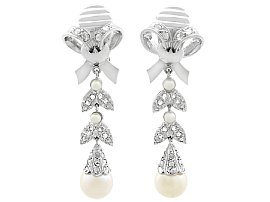
At AC Silver we have a range of antique and vintage silver jewellery boxes to suit all tastes and styles of decor, and we are able to offer our customers a collection of pieces from all over the world and from throughout the Victorian , Edwardian and contemporary eras. These pieces vary wildly between simplistic art deco boxes, to boxes with complex and delicate decoration.
Silver antique jewellery boxes make for wonderful gifts, especially for those with special pieces of vintage and antique jewellery to protect and present in a beautiful way.
Andrew Campbell hand picks all jewellery boxes added to the AC Silver inventory, and will only include the finest of their types.
Frequently Asked Questions
Jewellery boxes have taken on many forms and guises since their first conception in ancient Egypt, but traditionally speaking any receptacle whose purpose is to contain jewellery and precious items associated with jewellery can be considered a jewellery box. No matter which term you use; jewellery box, jewellery casket or trinket box- all have the same use, and only differ depending on perception of size and age.
Jewellery storage has always been incredibly important to jewellery lovers- from the earliest incarnations which were more akin to treasure chests; jewellery storage was primarily for the safekeeping of expensive items rather than for sustaining the quality of pieces.
Storing jewellery is contemporarily based in keeping jewellery compartmentalised and maintaining order, rather than safety and protection of the pieces. It is rare for modern jewellery boxes to feature a lock mechanism or any form of security feature, as they are usually stored within secure homes in the present day.
However, the method of storing jewellery that you choose is important when buying and collecting antique and vintage jewellery, particularly if your jewellery features gemstones. Although some stones are unaffected, there are some gemstones, such as amethyst, jadeite, quartz and opals, which should not be stored or exposed to direct sunlight and heat.
For owners of these stones, jewellery boxes provide an attractive way to maintain the quality of their jewellery whilst also being used for general storage. In short- the more precious your jewellery is- the more necessary a jewellery box is.
Originally, jewellery boxes were more similar to treasure chests, hence the term 'jewellery casket' being interchangeable with 'jewellery box'. The term jewellery casket is usually used when referring to a larger box, which would be considered slightly smaller than a chest, and usually raised on feet, rather than the base being flat to the surface which it rests on.
Jewellery boxes were in common use as early as 5000 BC in Ancient Egypt as the majority of Egyptians, male and female, wore jewellery. The Egyptians preferred material was gold, often encrusted with precious gems and as such, a secure, yet often well decorated box or casket was required to keep such items safe.
In Rome, jewellery was a status symbol, with only certain ranks permitted to wear rings for example. Fine brooches were used to secure items of clothing, and again, jewellery boxes were required for storage purpose.
Until the Victorian era, owning jewellery was a rare luxury, and to have enough jewellery to need storage for it was a privilege bestowed upon only a few members of royalty and high society.
Fine jewellery became more affordable to the mass market after the industrial revolution, due to the reduction in cost once machine cutting of stones and metal was possible. Jewellery boxes and caskets therefore became smaller, due to the necessity for more middle-class families to have in their homes, while only containing very few pieces of jewellery.
Trinket boxes were also common in Victorian households full of collectables and pieces of interest. These were much smaller than traditional jewellery boxes, accommodating smaller items such as rings and much fewer of them than is typical today.
Jewellery boxes, jewellery caskets and trinket boxes have all varied widely in their appearance over history. Ornate styles with elaborate detail were initially common, indicating outwardly the value of the items inside.
At the turn of the 20th century, novelty jewellery boxes enjoyed popularity. This was due to the Victorian's interest in filling their homes with decorative items of interest and intrigue, rather than simply owning that which was practical and absolutely necessary for daily life.
Novelty boxes were created to look as though they are a statue or are in the form of something else- such as an Edwardian jewellery box created in the form of a miniature 18th century card table.
The variety of styles and sizes of antique silver jewellery boxes mean that any taste can be catered to- everything from minimal clean lines or ornate floral decoration are available on our site, depending on the personal taste of the owner and their home décor. Antique and vintage jewellery boxes are timeless gifts that take pride of place in any home, and that are appreciated by all jewellery lovers and collectors.
Often confused with a funerary box, a casket is a decorative box that is commonly smaller than a chest. In the present day they are used to contain jewellery and trinkets, therefore are popular gifts and purchases to be used on dressing tables and even sideboards.
Traditionally, the casket was used to hold paperwork, back when a person would hold far fewer important documents. This allowed the progression of the locking mechanism to the front of the box. Caskets were similar to the modern day safe in this sense.
There are no limitations to the materials used to make a casket, many cultures monopolising their known handicraft to make a piece as important and intricate. The traditional precious metals of silver and gold are common for these types of boxes, but there is a grand multitude of examples in ivory, china and wood. Some caskets are highly embellished and others may be covered with a modest layer of leather or silk.
The Freedom Casket
There is one style of casket that would commonly be used for paperwork alone, and that would be the Freedom Casket. This decorative piece would be used to present a person with an important document and in the 19th century this would be a sealed freedom scroll; a piece to commemorate the conferring of the freedom of a town or city on a particular person. Once a vessel of this magnitude is used to deliver a letter, it is assured that the contents are serious or of high importance.
A silver jewellery box, whether antique or vintage, represents a meaningful and everlasting gift, perfectly suited for honouring life's most memorable occasions. Be it a birthday, anniversary, wedding, graduation, christening, or retirement, these boxes provide a blend of elegance and emotional significance.
Any more questions? Contact Us
Proud Members of